
There is a distinct moment of hesitation that almost every artist or collector feels when they bring a valuable piece of art into our studio. It is completely understandable; you are handing over a one-of-a-kind creation that represents hours of labor or years of history. You aren’t just looking for a photocopy; you are looking for assurance that the digital capture will honor the original medium. Over the years, we have learned that the difference between a mediocre print and a masterpiece usually happens long before the ink hits the paper—it starts with the quality of the scan.
Many clients initially assume that a high-resolution photo taken with a standard camera will suffice, only to be disappointed when they see the final proof. This is where professional Large-Format Art Scanning becomes the most critical step in your workflow. It is a specialized process that moves beyond simple photography, utilizing advanced optics and lighting to capture the soul of the artwork. Whether you are an artist preparing for a limited edition run or a gallery archiving a collection, understanding this process is key to preserving your visual legacy.
Why Standard Photography Often Fails Fine Art
We often see clients try to digitize their work using DSLRs and studio lights, and while the effort is admirable, the results rarely hold up to scrutiny. The primary issue with traditional photography is lens distortion and uneven lighting. Even with excellent equipment, a camera lens is curved, which can cause the center of the image to be sharper than the edges. Furthermore, lighting a large canvas evenly without creating glare on oil paints or varnishes is a nightmare in a standard studio setting.
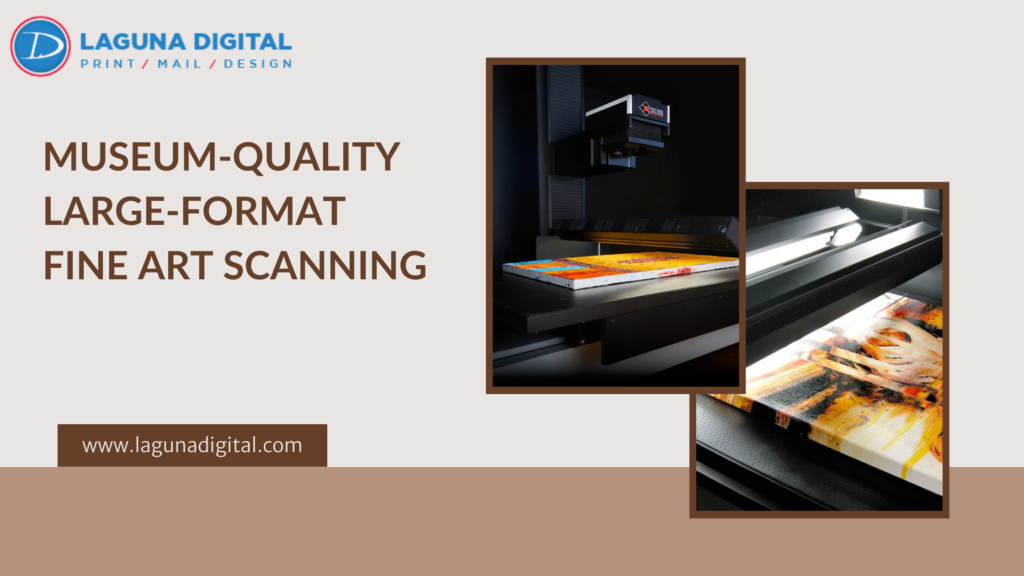
Our large-format scanners operate differently. They use a linear array sensor that captures the artwork inch by inch, ensuring that the lighting intensity and focal point are identical across the entire surface. If you want to dive deeper into the technical specifics of this equipment, you can read our guide on how large-format fine art scanning works. This method eliminates the hot spots and distortion common in photography, providing a flat, uniform digital negative that serves as the perfect foundation for future Art Reproduction.
Capturing Texture: The 3D Effect on Paper
One of the biggest complaints we hear from artists is that their prints look flat. When you work with heavy impasto, palette knives, or mixed media, physical texture is half of the visual experience. If a scan is lit too directly, it flattens out those ridges and valleys, making an oil painting look like a smooth poster. To counter this, we have to approach scanning with a deep understanding of how light interacts with physical surfaces.
We utilize lighting techniques that gently rake across the surface of the artwork. This creates microscopic shadows within the brushstrokes, which the scanner captures. When we eventually move to Digital Printing, those captured shadows trick the eye into seeing texture, even though the paper itself is smooth. It is this attention to the tactile nature of art that separates museum-quality archiving from standard document scanning.
Color Accuracy and the Human Element
Technology is incredible, but it isn’t perfect. A scanner can capture millions of colors, but it doesn’t possess the intuition of a human artist. We frequently work with pigments that are notoriously difficult to digitize, such as fluorescent neons or deep, dark indigos that tend to muddy up. This is where the human element of our service becomes indispensable. We don’t just hit scan and walk away; we actively monitor the color profiles to ensure fidelity.
After the initial scan, our technicians perform manual color balancing, comparing the digital image directly against the physical artwork under standardized lighting. This is similar to the precision required in high-end Photo Printing, where skin tones must be exact. In fine art, we are ensuring that your Cadmium Red doesn’t shift toward orange and that your watercolors retain their delicate transparency.
Logistics: Handling and Shipping Valuable Art
For local clients, dropping off art is simple, but we work with creatives and businesses across the country. Shipping large-format art requires careful planning to ensure the safety of the piece. If you are sending work to us from a distance, it is vital to use proper crating and tracking services. For insights on logistics and courier options, resources like blogs.trackcourier.xyz can be helpful for understanding shipping movements. Once the art arrives, it is handled with white-glove care, scanned without physical contact, and stored securely until it is returned to you.
Turning Digital Assets into Revenue
The ultimate goal for many of our clients is monetization. Once you have a master digital file, you open up the possibility of selling limited edition giclées, open edition prints, or licensing your work for commercial use. However, the file must be prepared correctly for these different outputs. A file optimized for a website portfolio is very different from one prepared for a 40×60 canvas print.
We specialize in guiding you through this transition. By utilizing Professional Art Reproduction Printing Services for Artists & Businesses, you ensure that the effort put into the scan translates into a sellable product. We help you choose the right archival papers and manage the file resolution so that your revenue stream is built on a foundation of quality.
FAQs
1. Is the scanning process safe for old or fragile artwork?
Yes, safety is our top priority. Our large-format scanners are non-contact devices. The artwork is placed on a flat bed (or the scanner moves over it), and nothing touches the painted surface except light. We regularly handle antique maps, crumbling watercolors, and sensitive mixed-media pieces. Because the artwork doesn’t need to be fed through rollers, there is zero risk of the machine damaging the substrate.
2. How large can you actually scan?
We can scan incredibly large pieces. For artwork that exceeds the single-pass dimensions of even our largest scanners, we use a technique callestitching. We scan the artwork in overlapping sections and use advanced software to merge them seamlessly. This allows us to create a single, high-resolution file for murals or oversized canvases without any loss of detail or visible seams.
Conclusion
At the end of the day, large-format fine art scanning is about preservation and possibility. It preserves the integrity of your original work in a digital format that will never fade, and it opens the possibility of sharing that work with a much wider audience through reproduction. It is a technical process, yes, but it requires an artistic eye to execute correctly.
We treat every canvas that comes through our doors with the respect it deserves, understanding that we are the guardians of your image during its time with us. If you are ready to digitize your collection or launch a print series, Laguna Digital is here to ensure the results are nothing short of spectacular. Let’s turn your physical masterpiece into a digital asset that lasts a lifetime.