
I’ve been working as a neurosurgeon in Ranchi long enough to remember when almost everyone with a serious brain or spine problem was told to head to Patna, Kolkata, or Delhi. That’s changing fast. Ranchi isn’t just the capital anymore, it’s quietly turning into the place where people get real neurosurgical care without having to leave the state. The shift didn’t come from one big new hospital or some flashy private chain. It came from steady upgrades at RIMS, a few good surgeons who chose to stay and build here, and more people realising that high-quality treatment is already available close to home.
RIMS – The Foundation That Kept Growing
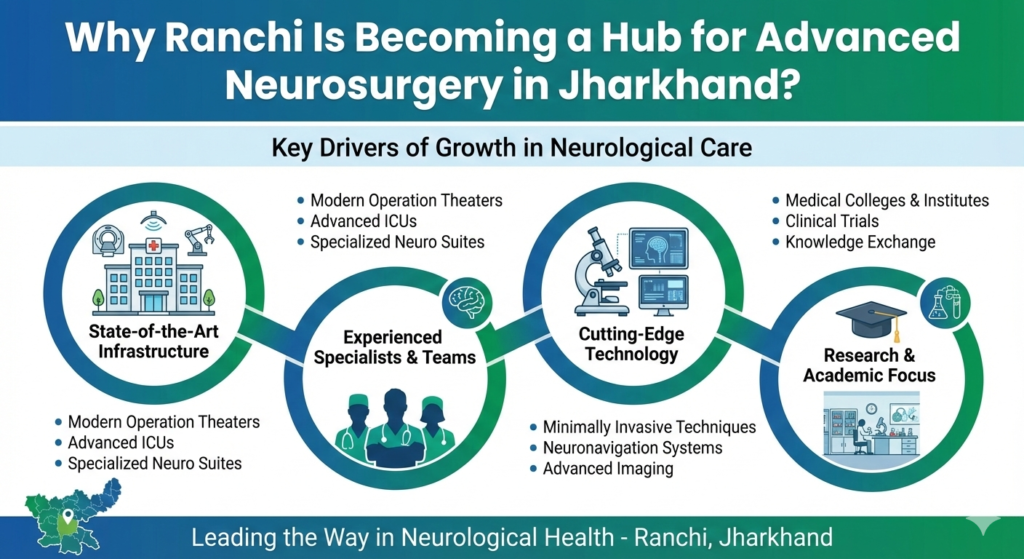
Rajendra Institute of Medical Sciences started as a typical government medical college hospital decades ago. The neurosurgery department was small back then, but it’s been adding real capacity year after year. They’ve increased dedicated beds (now around 110–130 including neuro-ICU and semi-ICU), brought in modern operating microscopes, endoscopic systems, C-arms for spine work, neuro-navigation, and even portable CT in some setups. It remains the only complete government neurosurgery unit in Jharkhand, so it sees the full range: emergency head injuries from road accidents, brain tumours, strokes, spinal fractures, disc herniations, TB spine, everything. For anyone in Ranchi or coming from nearby districts (Ramgarh, Hazaribagh, Giridih, Bokaro, Dhanbad) or even across the Bihar border, that means you can get seen, scanned, and operated on in days instead of waiting weeks for a metro hospital slot.
Surgeons Who Trained Here and Stayed Here
Not many doctors train in a place like Ranchi and then decide to build their career in the same city. Dr. Vikas is one who did. He completed his M.Ch at RIMS, saw the need, and stayed on. He’s strong on both brain and spine work: microsurgery and endoscopic techniques for brain tumours, neurotrauma (which we see a lot of because of accidents and falls), and a wide range of spine procedures, especially minimally invasive ones for slipped discs, lumbar canal stenosis, spinal tumours—cases that are everyday here. When a surgeon knows the local patterns (road trauma, TB spine, degenerative changes from heavy manual work) and doesn’t have to refer you out for every complication, that builds real confidence. Word spreads fast when people start saying, “I got fixed right here.”
Equipment That Matches the Job
The tools at RIMS have kept up with what neurosurgery actually needs. High-resolution microscopes give millimetre-level precision on delicate brain tissue. Endoscopes let us reach deep tumours or compressed nerves through tiny openings. C-arms provide clear real-time images during spine surgery so we don’t have to guess. Neuro-navigation helps when a tumour is sitting in a tricky spot. All of this adds up to smaller incisions, less blood loss, shorter ICU time, and quicker recovery. Patients leave the hospital sooner, and that kind of result gets noticed.
Cost That Doesn’t Force People to Delay
Money is still the biggest barrier for many families in this region. Ranchi keeps it realistic. Government rates at RIMS are low enough that even lower-income patients can afford an MRI, surgery, and follow-up without selling land or taking huge loans. Private consultations and procedures here run a fraction of what they cost in metros, yet the surgeons and support teams are experienced. That balance means people get treated before the problem becomes permanent nerve damage or disability. When care is affordable and close, people actually seek it.
Teamwork That Covers All the Angles
Neurosurgery isn’t a one-person job. At RIMS we coordinate with neurologists for stroke and epilepsy cases, radiologists for accurate imaging, critical-care doctors for post-op monitoring, and physiotherapists for rehab. When a patient has both a brain injury and a spinal fracture, like we see after serious road accidents the team plans together from day one. That kind of integration is hard to find in smaller towns where specialists are scarce and scattered.
Local Access That Changes Everything
For someone from Bokaro or Dhanbad, a 4-5 hour drive to Ranchi is doable; a 12–15 hour train to Delhi is exhausting and expensive. Follow-up visits become routine instead of major trips. Families can stay nearby, work and school aren’t disrupted for weeks, and recovery happens in familiar surroundings. When treatment is close, accessible, and reliable, more people actually get it and that’s how a city quietly becomes a hub.
If you or someone close is dealing with persistent radiating pain, numbness, weakness, balance trouble, chronic headaches with vomiting or vision changes, seizures, or any brain/spine symptom that basic treatment isn’t touching, don’t keep waiting. Early specialist care can stop permanent damage in many cases.
Book an appointment with the Best Neurosurgeon in Ranchi like Dr. Vikas at RIMS Ranchi, someone who knows the local patterns, uses modern techniques, and works with a strong team. Consult a Neuro Doctor in Ranchi who can give you a clear diagnosis and plan without the long-distance stress. In most cases, getting the right care right here changes the outcome more than travelling ever would.
read more about blogs.trackcourier.xyz